






In the lead-up to the European Athletics Championships, we look back at one of the greatest field event contests in championship history – Jordan Díaz producing the third-longest triple jump of all time to dethrone Pedro Pichardo in an unforgettable men's triple jump final at Roma 2024.
The background
Few modern rivalries in athletics have elevated an event quite like that between Jordan Díaz and Pedro Pichardo. Both former Cuban nationals, they arrived in Rome for the 2024 European Athletics Championships as two Iberian stars representing rival nations.
Pichardo, competing for Portugal, was the reigning Olympic, world and defending European champion, while Spain's Díaz had emerged as the sport's brightest new talent after switching allegiance and becoming eligible to compete internationally.
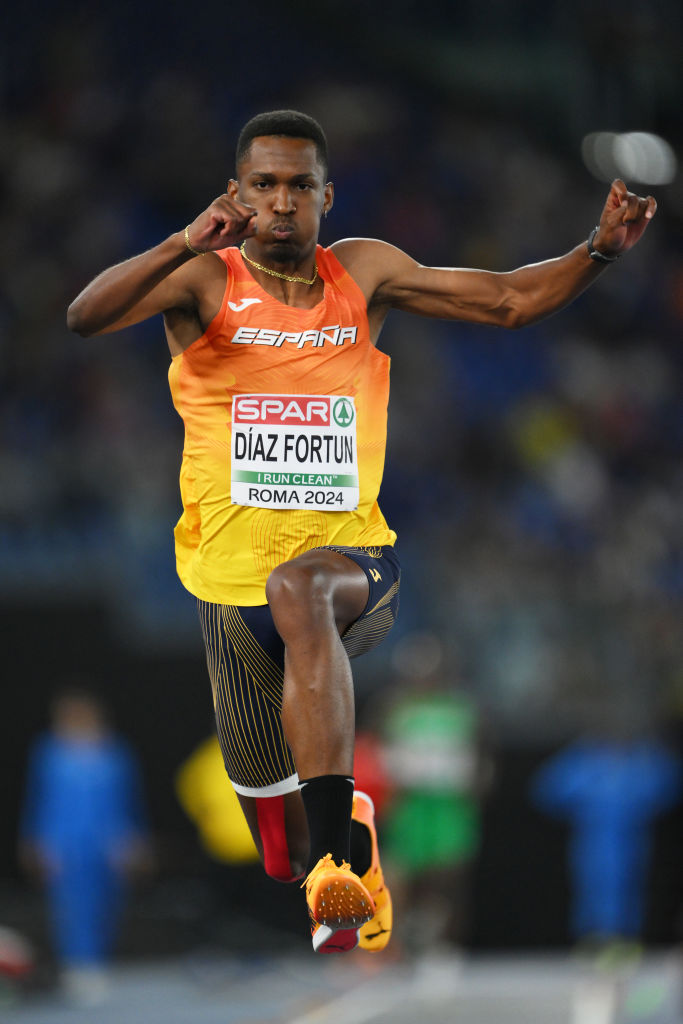
For Díaz, Rome represented his first major championship in Spanish colours.
The 23-year-old had long been tipped as a future global champion. A prodigious talent from Cuba, he had trained under the legendary Iván Pedroso before beginning a new chapter in Spain, where injuries had delayed his international breakthrough.
By contrast, Pichardo had spent years establishing himself as the benchmark in the event. Since claiming Olympic gold in Tokyo and world gold in Eugene, he had rarely been beaten when it mattered most.
The stage was perfectly set for a passing of the torch—or another demonstration of Pichardo's enduring greatness.
Standing behind them was a talented European field, but most observers expected the gold medal to be decided between the sport's two biggest names.
Few could have imagined just how spectacular that duel would become.
What happened?
Competing on the unique raised platform erected for the horizontal jumps at Roma 2024, the stage was set for a memorable men's triple jump final in front of a packed grandstand.
The competition exploded into life almost immediately.
Díaz opened with 17.56m before improving to 17.82m, but it was Pichardo who struck first. In the second round, the Portuguese star became the first athlete to surpass 18 metres at the European Athletics Championships, soaring out to 18.04m.
It instantly erased Jonathan Edwards' 26-year-old championship record of 17.99m from the record books.
For a few moments, it looked as though the contest had already produced its defining moment.
Díaz had other ideas.
After improving to 17.96m in the fourth round, the Spaniard unleashed a stunning fifth-round effort of 18.18m. The mark not only reclaimed the championship record but also elevated Díaz to third on the world all-time list, behind only Edwards and Christian Taylor.
Pichardo responded with everything he had.
His final attempt carried him out to 17.92m, but it was not enough to deny Díaz a famous victory. For the first time in European Athletics Championships history, two athletes had broken the 18-metre barrier in the same competition.
Thomas Gogois of France claimed bronze with a personal best of 17.38m, but the night belonged to the two men who had redefined what was possible.
Díaz's winning mark of 18.18m also stood as the third-longest legal triple jump in history.
The aftermath
Díaz's victory announced the arrival of a new European champion in emphatic fashion and confirmed that the men's triple jump had entered a thrilling new era.
Just two months later, the rivalry resumed at the Paris Olympic Games. Once again, Díaz prevailed, edging Pichardo by just two centimetres with 17.86m to secure Olympic gold and complete a remarkable breakthrough season.
Since then, Díaz has struggled with injury, competing only twice in the following two years. Meanwhile, Pichardo regained his world title, winning in Tokyo in 2025 with a dramatic final-round leap of 17.91m.
But it was Rome that provided the rivalry's defining chapter.
Two extraordinary athletes. Two jumps beyond 18 metres. One unforgettable evening that produced one of the greatest field event competitions in European Athletics Championships history.