

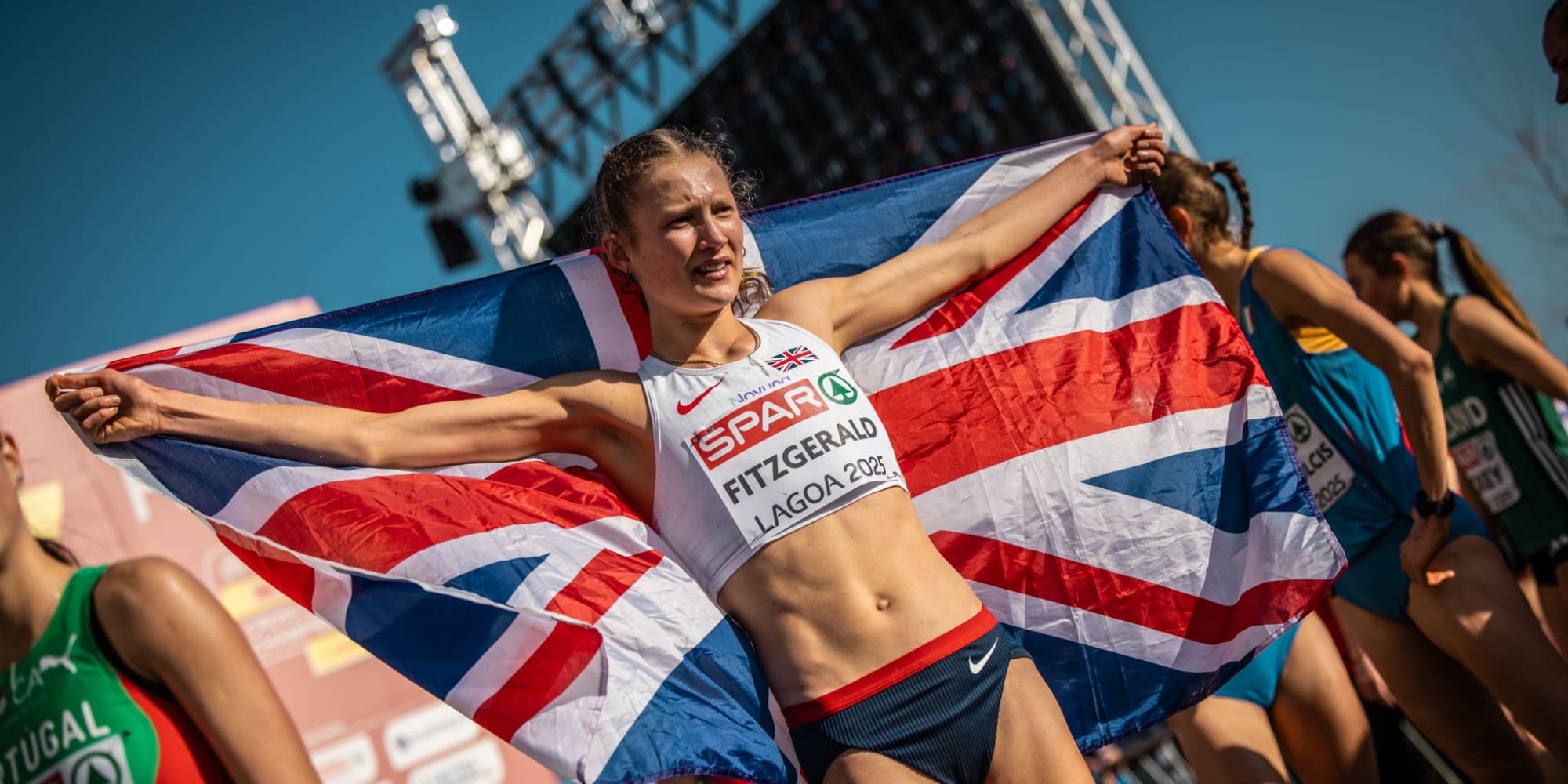


"I want to know that when I finish my career, I’ve not only succeeded in athletics but also done as much as I can in the environmental space,” so says one of the sport's rising stars, showing an awareness of the greater impact an athlete can make beyond their own career.
In athletics, performance comes first. But there is a growing awareness that success is not only defined by results, but also by how those results are achieved and the platform they create.
Athletes like multiple European U20 champion Innes FitzGerald are using that visibility to engage more thoughtfully with sustainability, while European Athletics is looking at how sustainable thinking can be reflected more clearly in the way the sport itself is delivered.
A growing awareness across the sport
Sustainability has long been part of the wider conversation around athletics, even if not always front of mind.
It has always been there in the background – in the logistics of international competition, in the realities of travel, in how events are delivered – but not always something that athletes or fans would directly connect to performance or progression.
However, that mindset is gradually changing.

There is a broader awareness now of the impact that sits around the sport, and a sense that, over time, small adjustments in how things are done can make a real difference. Some of that comes from athletes, some from organisers and Member Federations, and increasingly from both at the same time.
As ideas of success in athletics expand beyond results alone to include how those results are achieved, few athletes embody that shift more clearly than Innes FitzGerald.
A platform built through performance
Her perspective is not built on stepping away from elite sport, but on engaging with it while recognising the influence that comes with it. Like any athlete, her focus remains on improving, competing and progressing. What sits alongside that is an understanding of how visibility can be used more intentionally.
“I think if I can build a platform through athletics, then I can reach more people,” she says. “People follow sport, they follow journeys… and that gives you a way to bring other conversations into it.”
It’s a simple idea, but one that reflects a wider trend. More and more, athletes’ careers are creating opportunities beyond results alone – whether that’s sharing insights, raising awareness or influencing how certain topics are understood.
For FitzGerald, that influence doesn’t need to be forceful or directive.
“I never wanted other athletes to feel bad,” she says. “It’s just about making people think.”
Awareness, not pressure
Within a high-performance environment, the expectation is that athletes are there to perform. Anything beyond that has to sit alongside it, not compete with it, and it’s an important distinction.
“I think I’ve always been very aware of the impacts of what we do,” FitzGerald says. “Even just small things… and then as I’ve grown up and seen the sporting environment – the travel, everything around it – I haven’t really been able to disconnect the two.”

For many athletes, that awareness shows up in small, practical ways. Reusing kit, passing on items that are no longer needed, being more conscious about what is promoted or normalised.
These are not major interventions, but they reflect a slightly more considered approach to day-to-day decisions.
At the same time, there is a recognition that the bigger levers sit elsewhere.
“It gets a bit trivial if it’s just about what individuals are doing,” she says. “You have to think about the bigger picture.”
Supporting better decisions at a system level
That bigger picture is where organisations come in.
The structures that underpin athletics – competition calendars, travel arrangements, event delivery – shape the environment in which athletes operate. While individuals can make certain choices, many of the more significant decisions sit at an organisational level.
“Athletes are doing everything they can to be the best they possibly can be,” FitzGerald says. “Any extra mental energy trying to figure things out themselves takes away from that.”
In this context, the focus becomes less about individual responsibility in isolation, and more about how systems can support better decisions over time.
Through its Sustainability Programme and Roadmap, European Athletics is working to understand where those opportunities sit in practice. That includes how events are delivered, how host cities are engaged and how knowledge can be shared across Member Federations.
Initiatives such as Green Sports Hub Europe are aimed at supporting this with practical tools and guidance, while the Sustainability Ambassador Programme reflects an effort to bring athlete perspectives into the conversation in a more structured way.
The emphasis is on steady progress – identifying what can be improved, and building from there.
Europe’s practical opportunities
Within that wider picture, Europe offers certain advantages.
“The beauty of the European space is how close everything is,” FitzGerald says. “Travel between countries is generally pretty good.”

The proximity of countries, combined with established transport networks and a dense competition calendar, creates opportunities to look at how events are sequenced and how travel is planned. These are not always straightforward decisions, but they are areas where incremental improvements may be possible.
FitzGerald points to the idea of more connected competition blocks as one example.
“Having a series of races that you can kind of go from one to the other would be quite good,” she says. “Rather than going to one, going back home, then going out again.”
It’s the kind of thinking that also aligns with athlete experience and competition flow, not just sustainability.
Looking beyond the event itself
Another area where the conversation is developing is around what remains after events have finished.
FitzGerald highlights an example from a recent SPAR European Cross Country Championships course in Portugal, where the venue was designed with longer-term use in mind.
“Being able to bring something to improve the area for both the people and the environment – that’s quite nice,” she says.
This reflects a growing interest in how events can contribute positively to their host environments, whether through infrastructure, green space or community use. Across European Athletics events, there are increasing efforts to consider these aspects alongside the immediate delivery of competition.
Broadening the idea of success
For athletes, these developments add another layer to how their careers are experienced, even if performance remains the primary focus.
“I want to know that when I finish my career, I’ve not only succeeded in athletics but also done as much as I can in the environmental space,” FitzGerald says.
For her, that perspective sits alongside, rather than replaces, competitive ambition. It reflects a growing awareness that the platform created through sport can extend beyond results, even if that influence is used in relatively small or understated ways.
Leading by example
FitzGerald’s advice is simple and pragmatic. Not every athlete needs to speak out publicly, but there is value in being more conscious of the influence they already have. Often, it comes down to small, everyday choices, what you share, what you normalise, and what you choose not to promote.
As she puts it, “there are little things athletes can do… just being more conscious about what you post and making sure you’re not promoting things that are negative.”
For those who do feel strongly about certain issues, her message is to speak about what genuinely matters to you and not be afraid of the response. In her experience, that response has largely been positive, and she encourages younger athletes in particular to trust that their voice, used authentically, can carry real weight.
An ongoing conversation
If there is a common thread running through all of this, it is that the conversation is still evolving.
“If you spoke five years ago, the conversations we’re having now wouldn’t have been happening,” FitzGerald says.
Progress is not always linear, and different parts of the sport will move at different speeds. But there is a sense that sustainability is becoming more visible within athletics, not as a single issue to be solved, but as an area where awareness, practical action and longer-term thinking are gradually coming together.
For now, that may be enough. Not a complete shift, but a clearer understanding of where the opportunities lie, and how athletes and organisations, in different ways, can contribute to that over time.
European Athletics Leadership
“Sustainability must be part of how we define excellence in the sport itself," comments Karin Grute-Movin, Vice President and Development Commission Chair, European Athletics.
“Sustainability in athletics is no longer a parallel conversation, it must be part of how we define excellence in the sport itself. For European Athletics, that means embedding environmental and social responsibility into how we design championships, support our Member Federations, work with host cities and create long-term legacies for communities.
"What is encouraging is that this shift is being driven at both an organisational and individual level, hand-in-hand. Athletes like Innes FitzGerald are helping move the conversation forward by showing that performance and purpose can strengthen each other. Their voices challenge all of us – leaders, organisers and athletes alike – to think more intentionally about the choices we make.
"The real opportunity for our sport is to turn these conversations into practical action: smarter travel, more sustainable event delivery, stronger local legacy and better education across the athletics ecosystem. If we get that right, athletics can become a model for how sport contributes positively to society and the planet.”
Sustainability in partnership
“Sustainability in sport has to move beyond ambition and into practical decisions,” says Julio Fernando Fadel, Head of Global Marketing & Communication, CONICA.
“Sustainability in sport has to move beyond ambition and into the practical decisions that shape how facilities are designed, built and used over time. For surfaces, that means thinking carefully about durability, recyclability, resource use and long-term environmental impact from the outset.
"At CONICA, this mindset increasingly guides how we innovate and collaborate across the industry. Partnerships such as our work with European Athletics are an important part of that progress, helping ensure the future of sport is not only high-performing, but more responsible and resilient too.”