



“I just believed that my day would come.”
For Nadine Visser, that belief had been tested more thoroughly than for most. There had been fourth places, injuries and illness. There were major championship finals in which she had run superbly but still left without a medal, sometimes by the narrowest of margins.
So perhaps it was fitting that when Visser's day finally arrived, the margin of victory was one thousandth of a second.
At the European Athletics Championships in Birmingham, the Dutch hurdler finally claimed the major outdoor medal that had eluded her throughout a distinguished career, defeating Poland’s Pia Skrzyszowska by just 0.001 in a dramatic women’s 100m hurdles final.
Both were given 12.67 (+0.8m/s). Only the photo finish could separate them. This time, the verdict went Visser’s way, her shoulder edging it by 0.001.
“I got so many nice reactions,” she says. “So many people saying how happy they are for me, and they think it’s so well deserved.
“When I was so close to a medal, they were like, ‘Oh, I feel like you deserve this,’ and I was like, ‘It’s nice, but it doesn’t give me a medal.’
“Or like in the Olympics, where I ran a really good race, but it was a fourth place.
“It feels really nice to see that so many people support me in my journey and wish the best for me.
“And I feel like, finally, I can show them it was worth it to just keep on going. I just believed that my day would come, and it’s there now.”
At 31, Visser had already compiled a career most hurdlers would envy: two Olympic finals, multiple World Championships finals, two European indoor titles and world indoor bronze and silver medals.
But outdoors, the senior championship podium had remained stubbornly out of reach.
That made Birmingham about far more than one race.
From heptathlete to hurdler
Visser’s route to the top of the sprint hurdles was unconventional.
A former gymnast and footballer, she initially emerged as one of Europe’s outstanding multi-event prospects. At the 2014 World U20 Championships in Eugene, she demonstrated her remarkable versatility by winning bronze medals in both the heptathlon and 100m hurdles.
A year later, aged 20, she finished eighth in the heptathlon at the senior World Championships in Beijing. Her personal best of 6467 points, set that year, underlined just how accomplished a combined-events athlete she was.
She contested the heptathlon at the Rio 2016 Olympics and finished seventh at the 2017 World Championships before increasingly turning her attention to the hurdles.
The decision soon paid dividends.
At the 2018 World Indoor Championships in Birmingham, Visser won 60m hurdles bronze. A year later in Glasgow she became European indoor champion and successfully defended her title in Toruń in 2021, setting a Dutch record of 7.77.
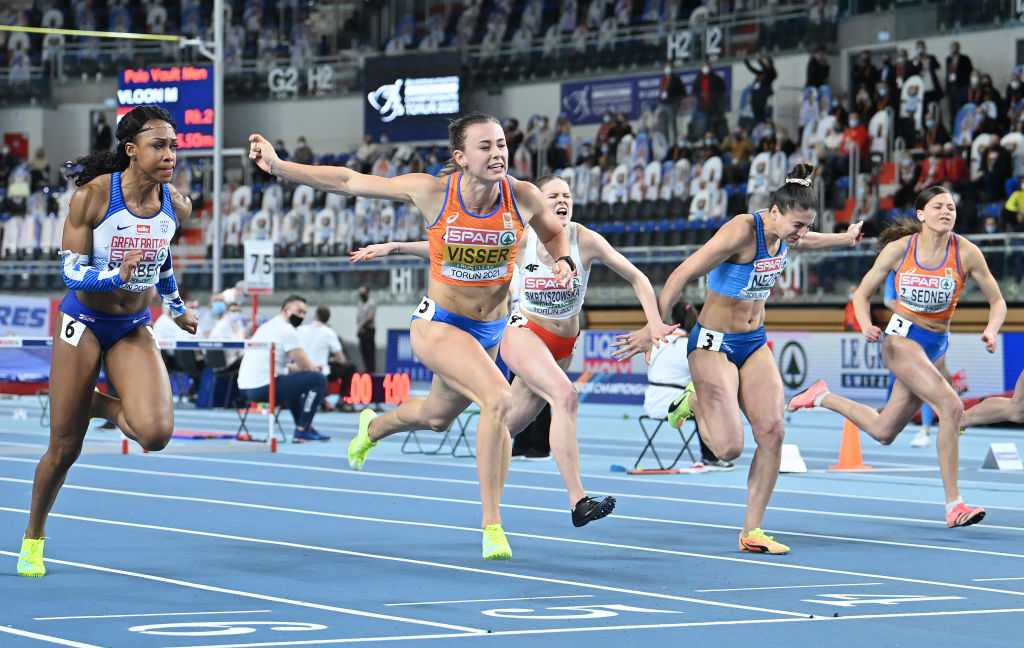
Indoors became the arena in which Visser collected the medals that continually escaped her outdoors.
European indoor silvers followed in 2023 and 2025, the latter on home soil in Apeldoorn where she lowered her Dutch record to 7.72. Earlier this year, she added world indoor silver in Toruń in 7.73 behind Devynne Charlton.
Four European indoor medals and two World Indoor medals proved Visser could deliver when championships were on the line.
Yet the outdoor medal remained missing.
“I’ve won many medals indoors,” she says. “I’ve already shown that I can do well at championships, but this is just really nice to now have an outdoor European medal.”
Fourth, fifth, sixth – but never on the podium
The frustration was heightened by how consistently Visser had put herself in contention.
She was fourth at the 2018 European Championships in Berlin, sixth at the 2019 World Championships in Doha – where she equalled her then Dutch record of 12.62 in the semifinal – and fifth at the Tokyo Olympics.
Then came Munich in 2022. It remains one of the races Visser finds difficult to revisit.
Skrzyszowska won the European title in 12.53, with Hungary’s Luca Kozák taking silver in 12.69. Switzerland’s Ditaji Kambundji took bronze in 12.74, with Visser fourth in 12.75.
For Visser, the disappointment was compounded by knowing her dip at the finish had not been good enough.
“2022 was, I think, physically and mentally my worst year,” she says. “Because of a hamstring injury and then struggling so much the whole season, leaving my coach, my grandma passing. So it was a lot.
“And still there I was close to a medal, but it was one hundredth of a second, and I didn’t have a good dip.
“I felt really guilty about that. This one was so frustrating for me, and still before this day, thinking about that was hard for me.”
There were other occasions when timing seemed to conspire against her.
“I’ve done really well, mostly at World and Olympic finals, and I often was the best European,” she says. “But always the year in between the Europeans, of course.
“I feel like often I was quite unlucky with the timing, also with physical issues. I had two hamstring injuries.”
Ahead of the Roma 2024 European Athletics Championships, another setback arrived.
“Two years ago I got sick, very sick in Doha, and the Europeans was very early, and I was not at my best there,” she says. She still reached the final and finished fifth in 12.72.
Two months later at the Paris Olympics, Visser produced one of the finest championship performances of her career.
She ran 12.43 in both the semifinal and final, finishing fourth, just seven hundredths behind bronze medallist Jasmine Camacho-Quinn.
Again, an outstanding performance brought no medal. “Like in the Olympics, I run a really good race, but it was a fourth place,” she says.
Visser reached another world final in Tokyo in 2025, finishing eighth, but that season also showed that, rather than fading as she entered her thirties, she was getting faster.
In August 2025 she ran a Dutch record of 12.28. The speed was there. So was the ambition. All that remained was for performance, health and opportunity to coincide at the right championship.
Birmingham breakthrough
In Birmingham, they finally did.
Four years after missing a European medal by a hundredth in Munich, Visser won European gold by a thousandth from Skrzyszowska.
For several seconds after the finish, neither woman knew.
Then the scoreboard delivered the answer: Visser first, Skrzyszowska second, both in 12.67. France’s Laeticia Bapté took bronze in 12.73.
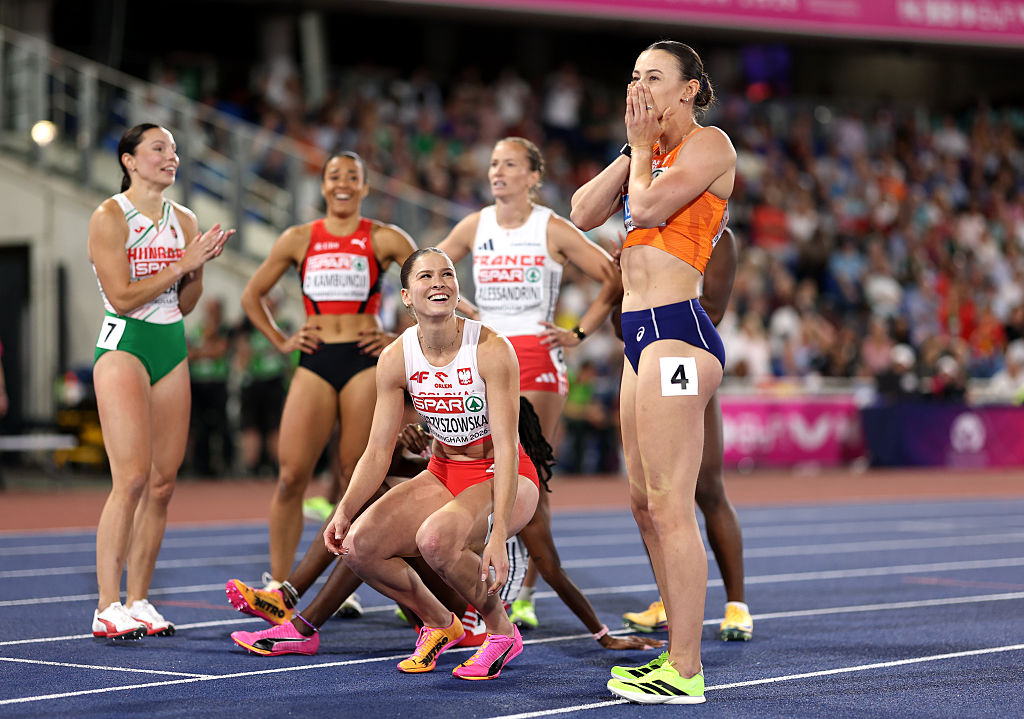
For a self-confessed perfectionist, even the greatest outdoor victory of Visser’s career prompted thoughts about what she could have done better.
“Someone was telling me, ‘This for sure must be a highlight of your career,’ and I was like, ‘Oh yeah, maybe.’
“I feel like it should be, yes, but I just need to let it sink in.
“I know it’s not only about winning the medals, but I’m also a perfectionist. The feeling of running a perfect race and running really fast times, I love that.
“When I’ve run really fast times, I felt so good, especially when I didn’t expect it. So it’s always nice to combine the two.”
Birmingham was not the perfect race. It did not need to be.
After years in which fractions of seconds, injuries and championship timing had worked against her, Visser finally had the result.
There was another pleasing element, too. The athlete she beat was Skrzyszowska, the woman who had won that painful European final in Munich four years earlier and a rival for whom Visser has considerable respect.
“I know Pia the best,” she says. “I feel like she really genuinely also is happy for me that I won. We work so hard.”
More in the tank
Gold has not brought a sense of completion. Visser believes the fastest race of her career may still be ahead of her.
“For sure,” she says. “I think I’ve not run the perfect race, and there is more in the tank.
“I had a few years where I could almost do the whole year of training and preparation well. So I think if I have another good winter and preparation – and I’m still learning – I can still improve.”
That is an intriguing prospect for an athlete who set her 12.28 national record at the age of 30. For years, Visser believed her day would come. In Birmingham, by the smallest possible margin, it finally did.
And she is not finished yet.